NEM BACK IN BLACK

On Wednesday last week the Energy Security Board (ESB) released a statement outlining that they had finalised advice on the redesign of the national electricity market (NEM) and handed the report to the Energy National Cabinet Reform Committee. This advice comes from a 2019 request to redesign the market to support the orderly transition to a modern energy system that allowed a rapid increase in the growth of large and small scale renewable energy.

Details of the advice is not publicly available but wording in the media release indicates that coal fired generation will play a key role in the transition. The statement outlines that there must be a coordination of the exit of aging coal fueled generation to maximise the opportunities and minimise risks associated with the transition to deliver affordable, smart, and clean energy.

The ESB consulted widely with industry stakeholders, conChanges to the generation mixsumer bodies, academics, government bodies and interested parties over the last two years. An options paper was released in April and the final advice is expected to closely reflect the options discussed.
Key areas we expect to be tackled in the final redesign advice is preparing for the older coal fired generation retirement, backing up power system security, unlocking benefits and opening the grid to cheaper large-scale renewables.

In preparing for the retirement of the older coal fired generation, the ESB want to give an incentive for the right mix of resources including renewables and non-renewable generation. This was to restore confidence in consumers that energy will be available when required and the mix will include intermittent generation like wind and solar as well as firm dispatchable generation like gas.

To tackle the need for a more secure power system, the ESB will require different ancillary services like inertia, voltage, and frequency control. A market for these services will be required to ensure the procurement and dispatch of these services save money while keeping the network electrically secure.

Further work will also include unlocking the benefits for all energy consumers to gain the advantages of rooftop solar PV, batteries, and smart appliances. Improvement in these areas may also include how consumers source their energy.

As generation is only part of the equation the need to reform the way electricity is transported is also a key redesign topic. Upgrading the network with the construction of transmission lines will reduce congestion and allow cheaper generation to be built in regional areas and improve the diversification of the grid by opening up more geographic locations.

The question most end users are asking is who is paying for all these improvements. As usual the end user will pay. The ESB is understood to be recommending capacity payments for electricity generators to remain online. These generators are likely to be the older coal fleet so consumers will be paying to keep higher carbon intensive technologies online rather than supporting renewables.

This situation will pay generators an available payment to generate when required. In reality, these units will not generate unless the market is at the point of load shedding.

Capacity payments are used in the Western Australian electricity market, under their current arrangements, generators receive capacity credits in line with their units generating capacity.

In the NEM if capacity payments are introduced, they will essentially offset the Reliability and Emergency Reserve Trader (RERT) costs currently used to provide a similar service.


EDGE NEWS – JULY NEWSLETTER

In this issue we look at the following;

  • We recently contracted 3 of Brisbane’s Largest Towers. How do we do it?
  • What is causing the increase in the spot &futures market prices?
  • What is aggregated electricity procurement and should you do it?

National NAIDOC week was celebrated during July and Edge acknowledge the Turral and Yuggera peoples as the traditional owners of the land on which our offices sit. We pay respect to elders past, present and future.

CHANGES TO THE GENERATION MIX

Last Tuesday saw a new record set for wind powered generation with NEM wide production reaching 5,899MW late in the afternoon. Wind made up 20% of the total generation at the time and on occasion peaked to 26% of NEM wide generation. As seen from my market commentary in recent weeks we have seen large fluctuations in available generation from intermittent sources such as wind and solar. In the past 6 months although peak wind production reached 26% it has also reached a low of just 2%. As more wind farms come online and are built across different regions, we will see more diversification of output. Currently Victoria leads the pack with the most wind generation followed by NSW and SA with TAS and QLD only contributing small amounts of wind generation.

In line with the increase in renewable generation, last year operational demand increased by 350MW primarily driven by cooler Q2 conditions and the opening up of the economy following the Covid lockdowns the previous year. LNG export prices have also increased as the world economy improved, this led to an increase demand in QLD for electricity in the gas production value chain. Overall wind and solar generation have reached record highs peaking at 57% market share in April.

Although the average operational demand has grown, the increased penetration of roof top PV reduced demand by 298MW between 10:00 and 14:30. Generation from intermittent sources such as wind and solar reached a record 7,368MW in the second quarter, 457MW more than the same quarter a year ago.

Coal fired generation dropped for a few reasons over the quarter, initially coal generation was being offset by renewable generation then interruptions in coal supply and unit failure lowered production.

The largest contributors to these reductions where Victoria’s Yallourn power station where flooding in the neighbouring mine reduced the output and a catastrophic failure at Queensland’s Callide C4. Following the failure of Callide C4, network protection took out a significant amount of coal units over the next couple of hours while the network was reinstated to isolate Callide power station. As a precaution the undamaged coal fired units at Callide remained offline for the following weeks while the cause of the initial failure was investigated.

With low and sometimes negative prices during the day due to high levels of rooftop PV, large scale solar and wind, the remaining generators tried to extract value from the morning and evening peaks. Historically this would have been taken up by coal fired generation but in Q2 gas powered generation (GPG) operated more due to the scarcity of coal fired units.

A record amount of 57% renewable generation occurred at 11:30 on 11th April, this was made be solar, roof top PV, hydro, and biomass, and was 1% more than the previous record seen in October 2020.

Although renewable generation has been high, restrictions on the network are limiting further output. Curtailment occurred for about 4% of semi-scheduled intermittent generation which was higher than Q1 primarily due to higher negative prices. Intermittent generation now their output at times of negative pricing to limit their exposure to the market. We also see an increase in the amount of curtailment resulting from network congestion and network constraints. In regions with very high levels of renewable penetration such as South Australia saw intermittent generation curtailed to manage AEMOs System strength concerns.

BRISBANE BASED BUSINESS CHARGING AHEAD

Currently Lithium-ion batteries provide various benefits over conventional batteries including charge time and weight. Li-S Energy is hoping to use lithium sulphur batteries which have a longer life, higher energy density and are even lighter than Lithium-ion batteries.

Lithium sulphur batteries can be cycled 600 cycles which is more than the current batteries. Advancement in this technology comes as a result of a joint venture between Deakin University and BNNT Technologies. Deakin University researched boron nitride nanotubes (BNNTs) which are pivotal to the advancement. Through the joint venture, BNNT Technologies will manufacturing the batteries.

BNNTs were only discovered in 1995, they are a very tough material comprising of nanotubes of Carbon, Nitrogen and Boron atoms. Until recently the challenge for these products was to develop them outside the lab and reduce the cost for them to be made.

The cost to produce the BNNT has been around $1M per kilogram, now the BNNT manufacturing facility at Deakin University’s Geelong campus has been setup to produce 50kg of BNNT per year per manufacturing module per shift.

The lithium-ion battery market is worth about $47.5 billion and is expected to double by 2025. A representative of the company would not state how many batteries could be made each year but believes the batteries would be competitive with other lithium-ion batteries.

Reducing the weight of batteries is crucial to the long-term success of EV’s and other devices. Li-S Energy believe removing the heavy elements that are in a lithium-ion batteries and are not required in lithium sulphur batteries will make the lithium sulphur battery very cost competitive considering the higher energy density.

Li-S Energy is expected to be listed on the ASX in August with an expected market cap of $544 million.

CHINA LAUNCHED NATIONAL CARBON EMISSIONS TRADING SCHEME (ETS)

Six years after the establishment of the scheme was pledged at the end of 2015, China has begun operating the national carbon Emissions Trading Scheme (ETS). This started on 16th July 2021, with the opening price of the Carbon Emission Allowances (CEAs) reported at CNY 48 (AUD 10.01) per ton. The first trading day concluded with the closing price of CNY 51.23 (AUD 10.68) per ton, up 6.7%. The total trading volume reached 4.1 million tons at CNY 210 million (AUD 43.79 million).
Shanghai Environment and Energy Exchange (SEEE) will handle account openings for traders and the operations of the new trading platform until a formal national carbon emissions quota trading operator is set up at a later stage. Trading in carbon emissions takes place from 9.30am to 11.30am, and from 1.00pm to 3.00pm Monday to Friday, much like the markets in Shanghai and Shenzhen. The national ETS initially set daily trading limits at 10% of prices and limits for block deals will be set at 30% of price moves.

According to ICAP, the ETS regulates more than 2,200 companies from the power sector, which emit more than 26,000 tCO2 per year. Its scope is expected to be expanded in the future. Currently, the ETS is intensity-based, with the cap being adjusted ex post, based on actual production levels. The compliance obligations are also limited.

While the new ETS is a part of China’s plans to make use of “market mechanisms” to help bring its carbon emissions – now the world’s highest – to a peak before 2030 and to achieve carbon neutrality by 2060. Critics have questioned its effectiveness due to its benchmark-based design, limited coverage, and the lack for a firm cap on emissions.

MINING EXEC JOINS RENEWABLE AGENCY

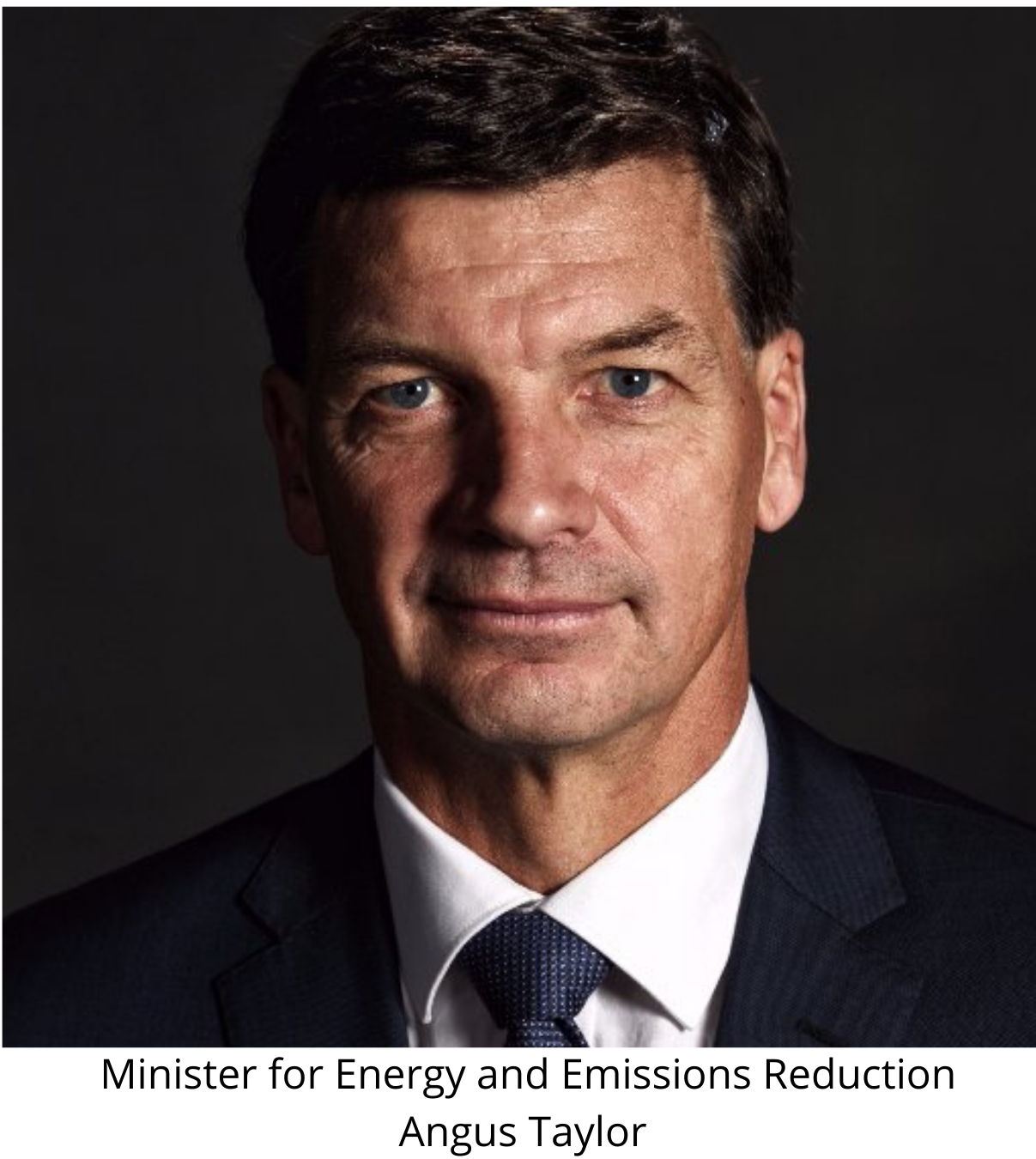
Scott Morrison and his Minister for Energy and Emissions Reduction continue to appoint mining executives to the Australian Renewable Energy Agency (ARENA). The next to be appointed is Stephen McIntosh from Rio Tinto. Fellow board member John Hirjee is also a former Rio Tinto executive.

As Rio Tinto is one of Australia’s largest coal producers, opponents to the appointments find it hard to understand how these executives can add value to the ARENA board.

However, Minister Angus Taylor said “that the addition of McIntosh would bring to the ARENA board experience in the production of the materials used in clean energy technologies like electric vehicles and battery storage”.

Taylor went on to say “Mr McIntosh is a former Rio Tinto Group Executive with experience in green metals, wind, solar and batteries. He has also worked across hydrogen and carbon capture technologies during his time with the company.”

Darren Miller, the CEO of ARENA, has had his contract extended for another three-year term and will work with other senior staff and board members to provide funding into the development of new clean energy technologies.

Questions have been raised about if ARENA is distributing its funding fairly with Rio Tinto awarded funding for a feasibility study into the use of Hydrogen at its Yarwun alumina refinery and the funding of the Kidston pumped Hydro project where renewable projects in the region were rejected.

BILLION DOLLAR GREEN ENERGY HUB

Spark Infrastructure, the partial owner of SA Power Networks, Transgrid, Powercor, CitiPower and the Bomen Solar farms is looking at developing a 2.5GW renewable energy hub in the middle of the South West Renewable Energy Zone (REZ) in NSW.

The Dinawan Energy Hub is strategically situated along the route of the planned interconnector between South Australia and NSW. The EnergyConnect project will be a 330KV interconnector running between Wagga Wagga and Robertstown in South Australia and will open up more than $20B of new renewables projects.

The Dinawan Energy Hub will be located halfway between Coleambally and Jerilderie and due to its location will support the existing network and the Humelink and Karanglink interconnectors.

The hub is expected to be completed by 2025 and is expected to include 1GW of wind, solar and battery storage. The $1.5B project will be undertaken in stages with the first stage expected to

commence construction in 2024.

Spark Infrastructure have completed the project identification stage of the development and now will undertake engineering studies and community consultation. The final investment decision is expected in 2024.

In some ways the Dinawan Energy Hub will compete with the NSW government’s plans to develop the REZ however Spark infrastructure believe the REZ and the energy hub can be developed together.

Spark Infrastructure is also in the news with a potential takeover bid for the multi-billion-dollar business.

Leading global investors including Kohlberg Kravis Roberts (KKR) and Ontario Teachers’ Pension fund have showed interest in investing in renewable energy and infrastructure projects in Australia.

It is understood these investors are looking at investing $5B to take over Spark Infrastructure.

If the takeover goes to plan, KKR and Ontario Teachers’ Pension Plan may add the Australian market to their target markets having recently bought a stake in Finland’s largest electricity distributor. KKR is also in the process of buying John Laing, a developer with interest in renewables assets in Australia.

BIGGER BATTERIES AND LARGER STORAGE

Back in 2017 following the black out of South Australia, the Tesla big battery was announced as the largest lithium-ion battery in the world. Weighing in at 100MW/150MWh the unit was big and provided enough storage to get regions through short duration period of high price of low availability. At the time, most people in Australia thought of batteries as a small segment of the industry and did not predict batteries to make any meaningful impact on the market for the next 10 to 20 years.

The Tesla big battery has now grown to 150MW/194MWh with the addition of extra batteries but has lost its title as the world’s largest and is likely to lose the title as Australia’s largest battery with Neon installing a 300MW/450MWh big battery near Geelong.

Now even Australia’s newest largest battery is about to be pushed off the top step as large scale wind and solar projects are installing larger, high-capacity batteries.

Most large-scale batteries in Australia have not been operating as storage devices, instead offering a service to “time shift” generation out of intermittent generation such as solar or wind to the time where the energy is required and returns better prices. The big batteries have predominantly been operating in the frequency market where they deliver network services such as frequency control ancillary services and synthetic inertia. To provide the network service the batteries operate for short sharp periods and as a result do not require large amounts of storage duration. As the competition in the network services segment of the industry increases the price for these services has reduced. Battery developers are now focusing on “time shifting” to provide better return for their projects rather than being exposed to low solar hour prices.

As coal fired generators retire the “duck curve” will deepen opening more opportunities for batteries to time shift the wind and solar generation into the evening peaks.  Developers are now looking for large duration storage to optimise their returns over the evening peaks. It now appears a 4-hour storage duration is the norm.

In recent weeks we have seen the large market players with significant thermal generation installed entering the battery developer market. Energy Australia is planning a 350MW big battery with four-hour storage at Yallourn.  AGL is constructing a 250MW big battery with four-hour storage at its Torrens Island site in South Australia which has announced the mothballing of its gas units. AGL also plans to replicate the 250MW battery at its Loy Yang coal site in Victoria. At Eraring, Origin is planning to install a big battery to offset generation when the coal fired power station closes.

The question is, if “time shifting” occurs, the times when the battery charges will likely raise spot prices as demand increases and the evening peak prices should drop. To make money battery operators will need to arbitrage the charging cost with the price they receive when they discharge. With the increased penetration of wind and solar generation into the generation mix the spot prices during the solar hours are likely to fall further however with many large-scale battery developers still heavily reliant on coal fired generation the optimisation of their exist portfolio will be interesting to see.

WHAT IS CAUSING THE INCREASE IN THE SPOT AND FUTURES MARKET PRICES?

A constraint designed to maintain power flow in the Gladstone region, primarily to maintain the continuous current rating on the 132kV feeder bushing at Boyne Smelter, is constraining off hundreds of MWs in Queensland.
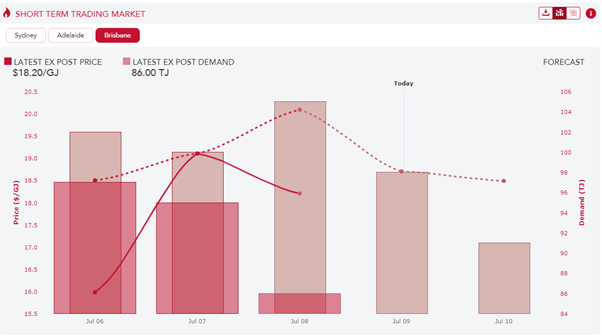
Constraints on the interconnectors out of Queensland are also limiting QLD generation. A constraint to avoid voltage instability on the Sapphire to Armidale 330kV transmission line is reducing NSW generation.

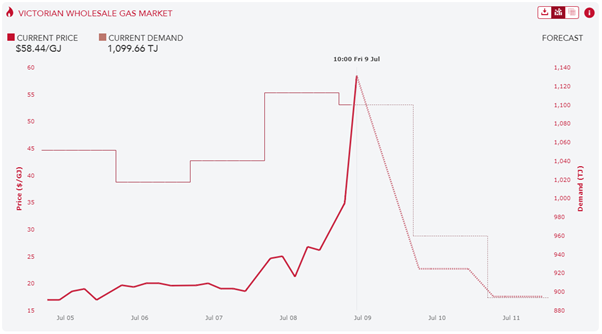
Constrained gas supply is also impacting spot prices. BHP’s Gippsland Basin joint venture with Exxon in Victoria, is not operating at full capacity due to a processing train at the Longford plant out of service since 28th June. This was due to an unplanned maintenance issue.

The unplanned issue at Longford has also reduced the output from the Bass strait gas fields that feeds the plant. The Iona gas storage facility operated by Lochard Energy is also running low.

The reduced level of generation from coal fired generation, resulting from the loss of Callide power station, the delayed return of Callide C3, and the reduced output of Yallourn in Victoria due to flooding have all added to the extra requirement for gas powered generation in QLD and VIC.

The requirement for extra gas-powered generation has led to higher prices in the gas market, which in turn leads to higher dispatch prices of the gas-powered generation. Higher dispatch prices lead to higher spot prices.

Domestic pressures on gas prices on the Australian wholesale market have been impacted by the overseas gas market demand and prices. As the Australian gas market is export dominated, any changes to overseas prices are reflected domestically. The benchmark Japan Korea Marker (JKM) is linked to the LNG netback price.

The JKM is also used as a floor for gas contracts in Australia and with the JKM lifting to $19/GJ this reflects in Australia. Today the Declared Wholesale Gas Market (DWGM) prices in Victoria is $58.44/GJ with a demand of 1,100TJ.

The futures market has responded to this week’s higher spot prices, along with the announcement that Callide C4’s return to service would be delayed until the end of 2022. The unit was planned to be in service by the end of 2021 and capable of supplying power over the 2021 summer however, the delay has pushed up the Q122 quarter prices as well as most of the quarters until 2023.

AGL DEMERGER

Last week AGL shared its plans to split the existing business into two. The announcement on Wednesday was not taken well by investors as shares dropped 10% when chairman Peter Botten made the announcement. The share price continued to fall through the week closing on Friday at $8.13 well below the $17.72 price a year ago. Investors are concerned that the two entities will lack the financial capacity to grow the businesses.

Accel, the coal fired part of the business will be led by current AGL CEO Graeme Hunt while Christine Corbett will run the retail business. Accel will earn its returns from carbon intense assets so institutional investors are steering clear of the business, Accel will also retain a 15-20% ownership of AGL Australia. Apart from a lower share price pushing investors away, it is also expected dividends will continue to fall for the 2022 financial year. AGLs retail business will retain the clean energy assets and the retail business.

The previous CEO of AGL Brett Redman proposed the demerger to evolve the business in a rapidly changing marketplace. Prior to the demerger AGL had consolidated to form a vertically integrated business, this worked well over recent years however the business structure is no longer optimal.

Customers are after a cleaner alternative to coal fired generation so the retail business that will retain the customers will be merged with the carbon neutral portfolio of assets resulting in customers sourcing their power from cleaner green generation sources.

While AGLs demerger does not seem to be seen by investors as a positive direction, Edge has previously highlighted that the splitting up of generation businesses is gaining momentum overseas with many fossils fuelled businesses creating businesses to develop a green focus and meet the customers’ demands. Time will tell if the demerge strategy will benefit to AGL.

Despite the negative outlook for Accel with its fleet of coal fired assets there is a positive light at the end of the tunnel. As the existing coal fired assets are retired Accel will retain their key location on the grid. Their favourable locations on the grid will allow Accel to transform the connection points from a high carbon emitting locations to low carbon hubs as new cleaner generation and storage is installed.